
TL;DR
-
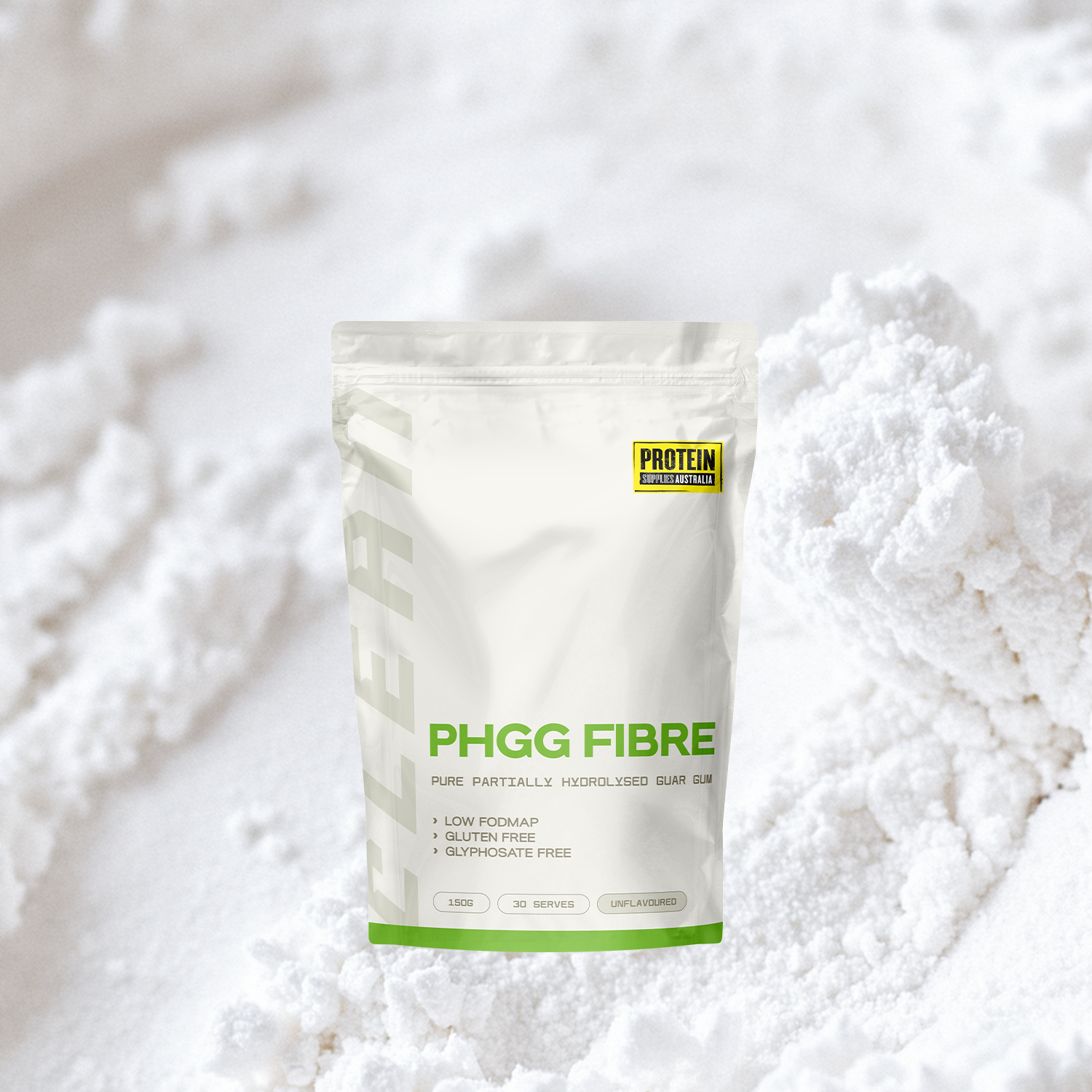
PHGG (partially hydrolysed guar gum) is a soluble, prebiotic fibre that dissolves completely clear and tasteless in any liquid.
-
It's clinically proven to relieve both constipation and diarrhoea, reduce IBS symptoms, and feed beneficial gut bacteria without the bloating that puts most people off other fibres.
-
The effective dose is 5 g/day, and most people notice a difference within 2–4 weeks of consistent use.
What Is PHGG Fibre?
PHGG stands for partially hydrolysed guar gum - a soluble dietary fibre made by breaking guar gum down into shorter molecular chains using a food-grade enzyme process. The result is a fine, white powder that dissolves completely in water, leaves no taste, no gel, and no gritty residue.

It's not a new ingredient. PHGG has been studied in human clinical trials since the early 1990s, and the body of evidence now spans well over 100 published studies. It's the same fibre your gut health practitioner or dietitian is most likely to recommend, and it's increasingly the go-to soluble fibre supplement in Australia for people who've had bad experiences with other options.
Where Does PHGG Come From?
Guar beans (Cyamopsis tetragonoloba) are a legume grown predominantly in India and Pakistan. The endosperm of the bean is rich in galactomannan - a long-chain polysaccharide that's also used as a thickening agent in food manufacturing (you'll see it listed as E412 in processed foods).
To make PHGG, that long-chain guar gum is enzymatically hydrolysed - essentially cut into shorter, more soluble fragments. This single processing step is what transforms a viscous, gel-forming food additive into a low-viscosity, gut-friendly fibre supplement.
PHGG vs Regular Guar Gum - What's the Difference?
|
Property |
Guar Gum |
PHGG |
|---|---|---|
|
Viscosity |
High - forms a thick gel |
Very low - stays liquid |
|
Solubility |
Partially soluble |
Fully water-soluble |
|
Gut tolerance |
Can cause bloating and blockage risk |
Well tolerated, even in sensitive guts |
|
Primary use |
Food thickener/stabiliser |
Dietary fibre supplement |
|
Prebiotic effect |
Minimal |
Clinically confirmed |
The key difference is viscosity. Regular guar gum swells with water and can literally slow or block gut transit - the opposite of what you want. PHGG retains all the prebiotic and fibre benefits while eliminating that problem entirely.
What Makes PHGG Different From Other Fibres?
Most people who end up researching PHGG have already tried something else and been disappointed. Psyllium that turned into a thick paste. Inulin that left them bloated for hours. Wheat bran that made things worse. PHGG is genuinely different - and the reason comes down to how it ferments.

PHGG vs Psyllium Husk
Psyllium (the active ingredient in Metamucil) is a gel-forming fibre. It works well for constipation by bulking stool - but that same gel-forming property can worsen bloating and abdominal discomfort, especially in people with IBS.
|
Feature |
PHGG |
Psyllium Husk |
|---|---|---|
|
Fermentation speed |
Slow, gradual, across the full colon |
Faster, concentrated in the upper colon |
|
Gel formation |
None - stays liquid |
Yes - forms a thick, viscous gel |
|
Bloating risk |
Very low |
Moderate to high in IBS |
|
Low-FODMAP certified |
Yes (Monash University) |
Yes, but gel can still trigger symptoms |
|
Dissolves clear |
Yes |
No - turns opaque and thick |
|
IBS evidence |
Strong across both IBS-C and IBS-D |
Strongest for IBS-C (constipation) |
Bottom line: If your gut is sensitive and bloating is your main complaint, PHGG is the better starting point. Psyllium has its place for constipation-dominant cases where stool bulk is the priority.
PHGG vs Inulin
Inulin (found in chicory root, Jerusalem artichoke, and many prebiotic supplements) is a rapidly fermented fibre. That speed is the problem - it produces gas quickly in the upper colon, which is exactly what causes the bloating and cramping that many people experience.
|
Feature |
PHGG |
Inulin |
|---|---|---|
|
Fermentation rate |
Slow and sustained |
Fast - concentrated gas production |
|
Bloating risk |
Low |
High, especially at doses >5 g |
|
Low-FODMAP |
Yes |
No - inulin is a FODMAP |
|
Suitable for IBS |
Yes |
Often not - can worsen symptoms |
|
SCFA production |
Yes - butyrate, acetate, propionate |
Yes - but with more side effects |
Inulin is a legitimate prebiotic, but it's not appropriate for anyone following a low-FODMAP diet or with a sensitive gut. PHGG delivers the same prebiotic benefit without the collateral damage.
Why PHGG Causes Less Bloating
PHGG ferments slowly across the entire length of the colon. Rather than producing a rapid burst of gas in one spot, fermentation is distributed and gradual. This means the gas produced is absorbed and expelled at a manageable rate - not enough to cause the distension and discomfort associated with faster-fermenting fibres.

A 2002 Italian multicentre trial (Parisi et al.) comparing PHGG directly to wheat bran in IBS patients found that while both improved bowel habits, PHGG was significantly better tolerated and preferred by participants. That preference gap is real, and it's consistent across the clinical literature.
What Does PHGG Actually Do? (Benefits)
Digestive Regularity (Constipation & Diarrhoea)
This is PHGG's headline act. It normalises bowel transit in both directions - which sounds counterintuitive, but it's well documented.
For constipation: a Greek RCT (Polymeros et al. 2014) found that just 5 g of PHGG daily for 4 weeks accelerated colon transit time, increased bowel movement frequency, and reduced laxative use in adults with chronic constipation. A Hong Kong RCT in elderly long-term care residents (Chan et al. 2022) showed the same laxative-reduction effect within 3–4 weeks.

For diarrhoea: Da Silva et al. (2022) demonstrated that PHGG extends small intestinal transit time - slowing the rate food moves through - which explains its effectiveness in diarrhoea-predominant presentations. Alam et al. (2015) showed PHGG added to oral rehydration fluid reduced the duration of severe watery diarrhoea in hospitalised children.
The mechanism is the same in both cases: PHGG regulates the rate of gut transit rather than forcing it in one direction.
IBS Symptom Relief
PHGG is one of the few fibres with solid clinical evidence across both IBS subtypes.
Russo et al. (2015) conducted a study in IBS-C patients (constipation-predominant) and found significant improvements in stool form, colon transit time, and laxative dependence with PHGG supplementation.
Yasukawa et al. (2019) ran a 3-month randomised, double-blind, placebo-controlled trial in IBS-D patients (diarrhoea-predominant) and found that 5 g of PHGG daily normalised stool form - moving participants closer to a Bristol Stool Scale score of 4 (the ideal).
Giannini et al. (2006) specifically examined PHGG's role in IBS treatment and confirmed its effectiveness in reducing global IBS symptom burden, with good tolerability across the study period.
For IBS, 5 g/day is the dose that appears consistently in the clinical literature. It's not a large amount - and the tolerability profile is far better than most alternatives.
Prebiotic Effect - Feeding Your Good Bacteria
PHGG is a confirmed phgg prebiotic - meaning it selectively feeds beneficial bacteria in the colon rather than being absorbed in the small intestine.
Reider et al. (2020) - the PAGODA Trial - specifically investigated PHGG's prebiotic effects on the human microbiome. They found meaningful increases in Bifidobacterium and Lactobacillus populations with regular PHGG intake.
Yasukawa et al. (2019) confirmed the same Bifidobacterium increase in their IBS-D cohort. Miyoshi et al. (2020) found similar microbiome shifts alongside improvements in defecation status in haemodialysis patients - a population with notoriously difficult gut function.
What's interesting is that PHGG doesn't appear to directly feed Bifidobacteria. Instead, it's degraded in the colon in a way that creates substrates that selectively favour their growth. The end result is the same: a more diverse, beneficial microbiome.
Short-Chain Fatty Acid (SCFA) Production
When gut bacteria ferment PHGG, they produce short-chain fatty acids (SCFAs) - primarily butyrate, acetate, and propionate. These are arguably the most important metabolites your gut produces.
Miyoshi et al. (2020) and Sakai et al. (2022) both demonstrated increased SCFA production with regular PHGG intake. SCFAs:
-
Fuel colonocytes - the cells lining your colon - supporting gut barrier integrity
-
Regulate water and ion transport across the colon wall, which is relevant to both constipation and diarrhoea
-
Support immune function - Sakai et al. (2022) found PHGG intake was associated with reduced cold-like symptoms, potentially via SCFA-mediated immune effects
-
May reduce systemic inflammation through gut-immune signalling pathways
Butyrate in particular is the primary energy source for colonocytes. A gut that's producing adequate butyrate is a gut that's functioning well at a cellular level.
Blood Sugar & Satiety (Secondary Benefits)
PHGG's soluble fibre properties slow gastric emptying and reduce the rate of glucose absorption from food. This blunts post-meal blood sugar spikes - a benefit that's relevant not just for people managing blood sugar, but for anyone who experiences energy crashes after eating.
The satiety effect is also real. Research published in the British Journal of Nutrition found that PHGG intake at meals reduced subsequent snacking by approximately 20% compared to a control. It's not dramatic, but for people using fibre as part of a broader weight management strategy, it adds up.
PHGG Dosage - How Much Should You Take?
The clinical literature is fairly consistent on dosage. Here's a practical breakdown:
|
Goal |
Starting Dose |
Maintenance Dose |
Notes |
|---|---|---|---|
|
General gut health / regularity |
3 g/day |
5 g/day |
Build up over 1–2 weeks |
|
IBS symptom management |
5 g/day |
5–6 g/day |
Consistent daily use is key |
|
Prebiotic / microbiome support |
5 g/day |
5 g/day |
Benefits build over 4–8 weeks |
|
Constipation (chronic) |
3 g/day |
5 g/day |
Drink adequate water |
|
Blood sugar / satiety |
5 g/day |
5–6 g/day |
Take with or just before meals |
The sweet spot across most studies is 5 g/day. Going higher (up to 10 g/day) has been used in some trials without safety issues, but 5 g is where the majority of clinical benefits are documented - and it's the dose most people can start on without any adjustment period.
Expert panels have concluded PHGG is safe at doses up to 20 g/day, with no interference with iron, mineral, or micronutrient absorption.
How to Take PSA PHGG Fibre
This is where PHGG has a genuine practical advantage over most other soluble fibre supplements.
-
It dissolves completely clear. No cloudiness, no residue, no sludge at the bottom of the glass.
-
It's tasteless and odourless. You will not know it's there.
-
It doesn't thicken your drink. Unlike psyllium, it won't turn your water into a gel if you leave it for 5 minutes.
That means you can stir PSA PHGG Fibre into:
-
Water, sparkling water, or juice
-
Coffee or tea (hot or cold)
-
A smoothie or protein shake
-
Yoghurt, oats, or any soft food
Start with 3 g (roughly half a teaspoon) for the first week, then move to 5 g daily. Take it at the same time each day - morning works well, and aligns with the protocol used in most clinical trials. Consistency matters more than timing.
PSA's Take
We chose PHGG as a standalone product because it's the fibre we kept seeing recommended by gut health dietitians and gastroenterologists - and because the clinical evidence is genuinely strong, not just plausible. Our PHGG Fibre Pure is a single ingredient: 100% PHGG, nothing else. No fillers, no flavours, no sweeteners, no anti-caking agents. Just the fibre, in the dose the research supports.
For first-time users: don't overthink the timing. Stir 5 g into your morning coffee or water and go. The fact that you won't taste it is the point - it should be invisible in your routine, not another supplement you have to choke down.
Who Is PHGG For?
PHGG is a particularly good fit if you:
-
Have IBS (either constipation or diarrhoea-predominant) and haven't tolerated other fibres well
-
Are following a low-FODMAP diet - PHGG is Monash University Low FODMAP Certified™, making it one of the very few prebiotic fibres safe in this context
-
Experience bloating or gas with other fibre supplements (psyllium, inulin, FOS)
-
Are constipated and want a gentle, non-laxative approach
-
Want to support your gut microbiome without adding a flavoured or sweetened product to your diet
-
Are recommended PHGG by a practitioner and want a pure, unflavoured soluble fibre supplement in Australia without unnecessary additives
It's also used in clinical nutrition settings - tube-fed patients, elderly populations, and post-surgical recovery - which speaks to its safety and tolerability profile.
Is PHGG Safe? Side Effects & Considerations
PHGG has an excellent safety record. It's been studied across diverse populations - children, elderly adults, IBS patients, haemodialysis patients - and consistently shows a low side effect profile.
Possible side effects, particularly when starting:
-
Mild bloating or increased gas in the first few days - this typically settles within a week as your gut microbiome adjusts
-
Loose stools if you increase the dose too quickly - start at 3 g and build up
Who should check with their GP or dietitian first:
-
People with a known gut motility disorder or intestinal stricture
-
Anyone on medications that require precise absorption timing (PHGG may slightly slow gastric emptying)
-
Pregnant or breastfeeding women - not because PHGG is known to be unsafe, but because clinical data in this population is limited
PHGG does not interfere with the absorption of iron, calcium, or other micronutrients - a concern with some other fibres. It's gluten-free, non-GMO, vegan, and halal certified (when sourced as Sunfiber®).
Useful Sources
-
Alam NH et al. (2015). Efficacy of PHGG supplemented oral rehydration solution in severely malnourished children with watery diarrhoea. Journal of Health, Population and Nutrition. pubmed.ncbi.nlm.nih.gov/26825665
-
Russo L et al. (2015). Partially hydrolyzed guar gum in the treatment of irritable bowel syndrome with constipation. Saudi Journal of Gastroenterology. pubmed.ncbi.nlm.nih.gov/25843197
-
Yasukawa Z et al. (2019). Effect of repeated consumption of PHGG on fecal characteristics and gut microbiota. Nutrients. pubmed.ncbi.nlm.nih.gov/31509971
-
Giannini EG et al. (2006). Role of partially hydrolyzed guar gum in the treatment of irritable bowel syndrome. Nutrition. pubmed.ncbi.nlm.nih.gov/16368215
-
Reider SJ et al. (2020). Prebiotic effects of PHGG on the composition and function of the human microbiota - PAGODA Trial. Nutrients. pubmed.ncbi.nlm.nih.gov/32365622
-
Da Silva MVT et al. (2022). Acute intake of FOS and PHGG on gastrointestinal transit. Nutrition. doi.org/10.1016/j.nut.2022.111737
-
Miyoshi M et al. (2020). Prebiotics improved defecation status via changes in microbiota and SCFAs in haemodialysis patients. Kobe Journal of Medical Sciences. pubmed.ncbi.nlm.nih.gov/32843622
-
Sunfiber® PHGG certifications and research overview: sunfiber.com/partially-hydrolyzed-guar-gum-phgg
-
Dietary fibre overview - Healthdirect Australia: healthdirect.gov.au/dietary-fibre
-
Fibre and digestive health - Better Health Channel (Vic): betterhealth.vic.gov.au/health/healthyliving/fibre-in-food
How Much Protein Do You Need Per Day? A Goal-by-Goal Breakdown
What Supplements to Take and When: A Practical Timing Guide