
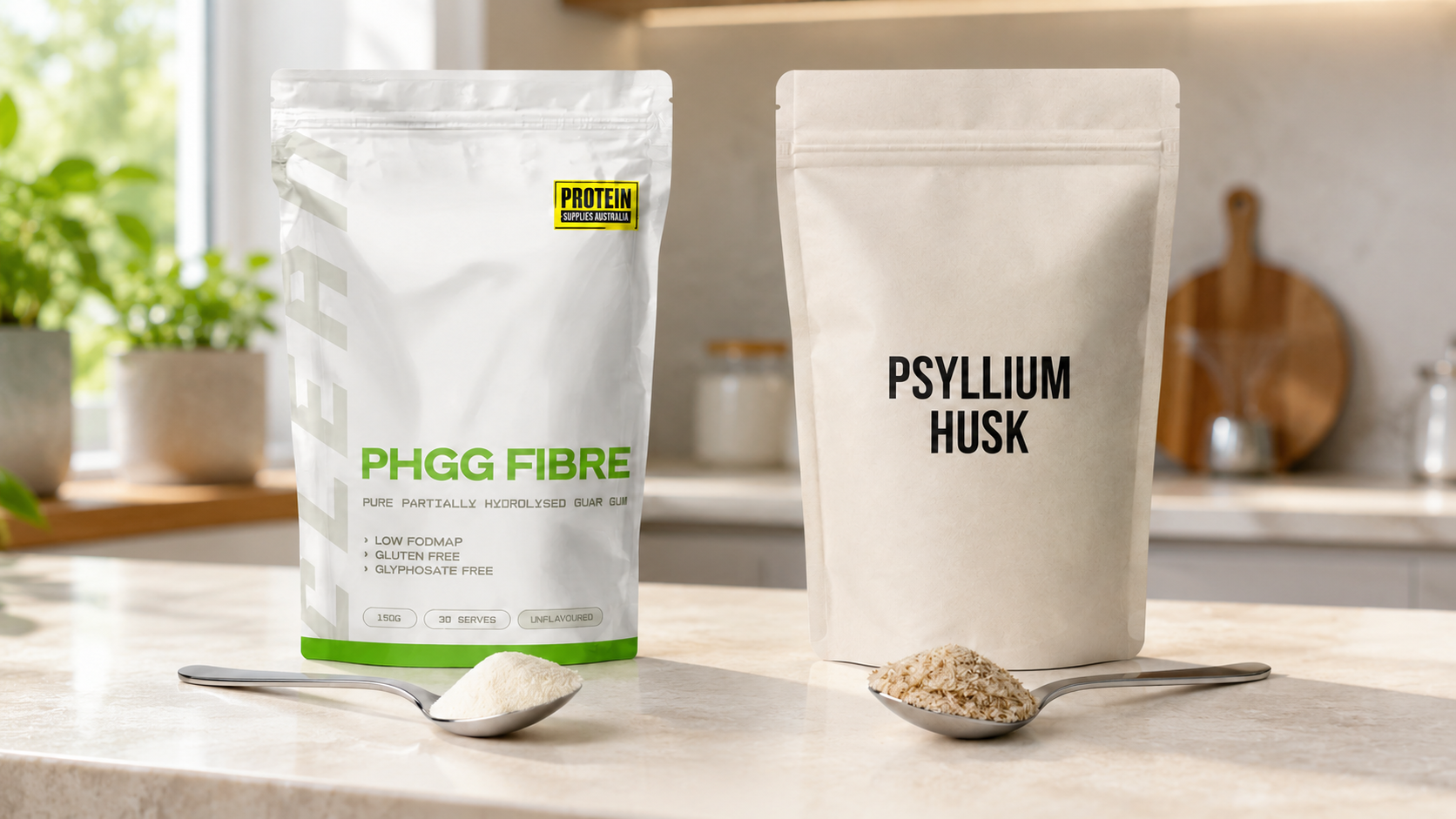
PHGG vs Psyllium Husk Fibre. Which is better?

For most people, start with PHGG. It's the gentler, more versatile default - low FODMAP, fully soluble, doesn't gel, virtually tasteless, and easy to take every day without your gut noticing much of a transition.
-
Choose PHGG (partially hydrolysed guar gum) as your default fibre supplement if you have a sensitive gut, diagnosed IBS, bloat easily, or you're simply new to taking fibre and want the lowest-risk starting point.
-
Choose psyllium husk only in the narrower case where you already know your gut tolerates a viscous, bulk-forming fibre well and you specifically need its proven cholesterol-lowering effect.
-
If you're not sure, start with PHGG. It's the safer entry point for almost everyone, and you can always look at psyllium later once you know exactly how your gut responds and whether you need its specific cholesterol benefit.
Both are legitimate options for anyone trying to hit the recommended 25–30g of fibre a day (source: Eat for Health), and both show up constantly in searches for the best fibre supplement and general fibre for digestion advice. But if you're weighing up which one to actually buy, PHGG is the lower-risk, more broadly tolerated choice for daily use.
What Is PHGG (Partially Hydrolysed Guar Gum)?
PHGG is made by enzymatically breaking down guar gum - a fibre extracted from the guar bean (Cyamopsis tetragonoloba), grown mainly in India and Pakistan. That hydrolysis process is what makes PHGG different from regular guar gum: it shortens the fibre chains, which drops the viscosity right down while keeping the fibre 100% soluble.
Key traits:
-
Source: Guar bean seed, processed to reduce molecular weight and viscosity.
-
Solubility: Fully soluble - dissolves clear in water or juice, doesn't turn into a gel or thicken your drink.
-
Gentleness: This is PHGG's real selling point. Because it's low-viscosity, it moves through the gut without the sudden bulk or gel formation that trips up sensitive systems.
-
FODMAP status: Monash University has laboratory-certified specific PHGG products (such as Sunfiber-based supplements) as low FODMAP at standard serving sizes of roughly 5–7g/day - one of the very few fibres cleared for use during a FODMAP elimination phase (Monash FODMAP, 2023).
-
Prebiotic effect: PHGG feeds beneficial bacteria like Bifidobacteria and Lactobacillus in the large intestine, and research shows it can increase short-chain fatty acid production without the gas spike you'd expect from a fermentable fibre (PMC, 2015).
Clinical trials using 6g/day of PHGG for at least 12 weeks reported meaningful improvement in bloating and gas in IBS patients, with benefits persisting for weeks after stopping - and no significant side effects reported across the studies reviewed (PubMed; PMC, 2015).
What Is Psyllium Husk?
Psyllium husk comes from the seed coat of Plantago ovata, a plant grown mainly in India. It's one of the oldest and most studied fibre supplements around, and it's the active ingredient in most over-the-counter bulk-forming laxatives.
Key traits:
-
Source: Outer husk of the psyllium seed, ground into a powder or sold as whole husk/flakes.
-
Solubility: Around 70% soluble fibre, but the defining feature is what it does once it's wet - it absorbs many times its weight in water and forms a thick, mucilaginous gel almost instantly (Better Health Channel).
-
Common issues: That gel-forming action is exactly why some people struggle with it. Common complaints include:
-
Bloating and gas, especially in the first week or two.
-
Viscosity that's hard to drink - it can thicken in the glass within seconds if you don't drink it fast.
-
Choking risk if taken without enough fluid, or by people with swallowing difficulties (Better Health Channel).
-
-
Proven benefits: Regular use of 7–10g/day has been shown to lower LDL cholesterol by 6–18%, largely by binding bile acids in the gut (Better Health Channel). It's also a genuinely effective bulk-forming laxative for constipation.
Psyllium works - the evidence base is decades deep - but it demands more from your gut and your glass of water than PHGG does.
Side-by-Side Comparison
|
Factor |
PHGG |
Psyllium Husk |
|---|---|---|
|
Solubility |
100% soluble fibre |
~70% soluble fibre, rest insoluble |
|
Fermentation / gas potential |
Slow, gentle fermentation - low gas, low FODMAP |
Higher fermentation potential; gas and bloating common early on |
|
Viscosity / gel effect |
Low viscosity - mixes clear, no gel |
High viscosity - thickens/gels rapidly |
|
Taste/texture |
Virtually tasteless, no grit |
Slightly gritty; can feel "slimy" once gelled |
|
Dosage flexibility |
Easy to adjust; mixes into hot or cold liquids without changing texture |
Less flexible - must be drunk immediately before it sets |
|
IBS-friendliness |
Monash-certified low FODMAP; well tolerated by IBS-C and IBS-D |
Can trigger symptoms in sensitive IBS guts if increased too fast |
|
Prebiotic effect |
Documented prebiotic action (feeds Bifidobacteria, Lactobacillus) |
Limited prebiotic fermentation; acts mainly as bulking/gel-forming agent |
Which fibre is right for you?
Answer 4 quick questions and get a simple recommendation.
Question 1 of 4
What's your biggest goal?
Question 2 of 4
Do you have IBS or a sensitive gut?
Question 3 of 4
Have you taken fibre supplements before?
Question 4 of 4
What matters most to you?
PHGG is likely your best fit.
Your answers suggest you are looking for a gentle, everyday fibre that is easy to drink and suitable for sensitive digestion. PHGG ticks those boxes with its low-viscosity, low FODMAP profile.
Psyllium husk may suit you best.
Your answers suggest cholesterol support is your main priority. Psyllium husk is the more targeted pick for that use case, provided your gut already tolerates a viscous, bulk-forming fibre well.
Which One Is Right for You?
Sensitive gut or diagnosed IBS? → PHGG If bloating, gas, or unpredictable bowel habits are your main issue, PHGG is the safer starting point, full stop. Its low-FODMAP certification and slow fermentation profile make it one of the few soluble fibre supplements dietitians recommend during a FODMAP elimination phase.
New to taking a fibre supplement at all? → PHGG If you've never used a fibre supplement before and don't yet know how your gut will react, PHGG is the more forgiving place to start. It's fully soluble, doesn't gel, and the slow fermentation profile means you're far less likely to get put off fibre altogether by a rough first week.
Taste and texture matter to you? → PHGG Because it's virtually flavourless and doesn't gel, PHGG blends into coffee, smoothies, or plain water without changing the mouthfeel. Psyllium's texture is harder to mask, especially once it starts thickening - and that's often the reason people give up on it.
Want a fibre you can take daily, long-term, without thinking about it? → PHGG For everyday, ongoing use, PHGG's consistency is the appeal: same texture, same mixability, no gel-timing to manage. It's the more practical daily habit for general regularity and overall fibre intake, not just for sensitive guts.
Already know your gut tolerates psyllium well, and specifically need cholesterol support? → Psyllium husk This is the one scenario where psyllium is the more targeted pick: if you have a proven need to lower LDL cholesterol and your gut already handles a viscous, bulk-forming fibre without issue, psyllium's decades-deep evidence base for cholesterol reduction is hard to beat. Outside that specific case, it's a narrower recommendation than PHGG, not an equal alternative.
On a budget? Psyllium is a commodity product and cheaper per gram upfront. But that's not the whole cost picture: PHGG typically costs more per serve because of the extra processing step, and for most people that difference is offset by better tolerance and more consistent day-to-day use - you're not paying for a supplement you end up abandoning after a bloated first week. Factor in the wasted product and the false starts, and PHGG's per-serve premium is easier to justify than it looks.
Dosage & How to Introduce Fibre Safely

Whichever you choose, the same rules apply - this is standard dietitian advice for any digestive health supplement, not just these two:
-
Start low. Begin with 1–3g/day (roughly a quarter to half the label dose) rather than jumping straight to a full serve.
-
Increase gradually. Add another gram or two every 3–5 days if you're tolerating it well. Give your gut bacteria time to adjust - sudden jumps are the main reason people blame fibre for bloating.
-
Hydrate properly. Both fibres need fluid to work. Psyllium in particular should be mixed with at least 250mL of water per teaspoon and drunk immediately (Better Health Channel). Under-hydrating with psyllium is the fastest way to end up constipated instead of regular.
-
Typical clinical doses: PHGG studies commonly use 5–7g/day; psyllium studies commonly use 7–10g/day split across two doses. These aren't hard ceilings, but they're a reasonable target once you've built up tolerance.
-
Talk to a health professional if you have a diagnosed GI condition, are on medication (fibre can affect drug absorption timing), or you're pregnant or managing diabetes.
Useful sources
Disclaimer: This article and quiz are intended for general educational purposes only and should not be considered medical advice. The quiz provides a general recommendation based on the answers you provide and does not take into account your complete medical history, medications or individual health needs. If you have a diagnosed medical condition, are pregnant or breastfeeding, take prescription medication, or have ongoing digestive symptoms, speak with your GP, accredited practising dietitian or other qualified healthcare professional before making changes to your diet or starting a new supplement.
What Supplements to Take and When: A Practical Timing Guide
Sticky Date Baked Oats with Salted Caramel Collagen