
TL;DR
-
Marine collagen = hydrolysed fish collagen peptides, predominantly Type I collagen
-
Best evidence: skin elasticity, hydration, and nail strength - backed by VERISOL® F clinical trials
-
Standard dose: 2.5–10 g/day depending on your goal (up to 20 g for joint/connective tissue support around exercise)
-
PSA uses VERISOL® F - one ingredient, no fillers, clinically validated source
-
Choose marine for skin and beauty goals; choose bovine for joints and recovery; stack both for comprehensive support
What is marine collagen?
Marine collagen comes from fish - specifically the skin, scales, and bones of whitefish. These are by-products of the seafood industry, which makes marine collagen a relatively sustainable protein source.

The key process is hydrolysis. Raw fish collagen is broken down enzymatically into short-chain peptides - this is what "hydrolysed marine collagen" means. The result is a fine, water-soluble powder that mixes easily into liquids and is far more bioavailable than native (unprocessed) collagen.
Type I collagen only. Marine collagen is almost exclusively Type I collagen - the same type that makes up skin, hair, nails, tendons, and bones. This is different from bovine collagen, which contains both Type I and Type III.
Amino acid profile: The dominant amino acids are glycine, proline, and hydroxyproline. These are the building blocks your body uses to synthesise new collagen in skin and connective tissue.
Marine collagen vs other collagen types
|
Type |
Source |
Collagen types |
Best for |
|---|---|---|---|
|
Marine (fish) |
Fish skin, scales, bones |
Type I only |
Skin, hair, nails |
|
Bovine |
Cattle hide, bones |
Type I + III |
Joints, gut, recovery |
|
Plant-based "collagen boosters" |
Vitamin C, amino acids |
None - no actual collagen |
Supporting your own synthesis |
The honest takeaway: plant-based products contain no collagen. They may support your body's own production, but they're not a direct source.
For a full breakdown of which source fits your goals, read our guide on marine collagen vs bovine collagen.
Marine collagen benefits - what does the science actually say?
Marine collagen has a solid evidence base for skin and nail outcomes. The joint and gut evidence is thinner - we'll be straight about that.
Skin elasticity and hydration are the best-supported benefits. A 2014 double-blind, placebo-controlled RCT by Proksch et al. (Skin Pharmacology and Physiology) found that women aged 45–65 taking VERISOL® bioactive collagen peptides for 8 weeks saw a 20% reduction in eye wrinkle volume, a 65% increase in procollagen Type I, and an 18% increase in elastin - with effects persisting 4 weeks after stopping. Crucially, there was no meaningful difference between the 2.5 g and 5 g doses.

Nail strength is also well-supported. Hexsel et al. (2017, Journal of Cosmetic Dermatology) ran a 24-week open-label trial with 25 participants taking 2.5 g of VERISOL® daily. Results: 12% faster nail growth, 42% fewer broken nails, and 88% of participants reported improvement even 4 weeks after stopping.
Hair growth has emerging support. Hwang et al. (2022, International Journal of Molecular Sciences, PMC9569759) found that fish collagen peptides increased proliferation of human dermal papilla cells in vitro and improved hair regrowth and anagen/telogen ratio in mice over 6 weeks. This is biological plausibility - not yet human clinical proof - so temper expectations accordingly.
Joint support is secondary for marine collagen. Type I collagen is present in tendons and cartilage, and the amino acid glycine has shown anti-inflammatory properties in animal models. But if joint health is your primary goal, bovine collagen (with its Type I + III profile) is a better fit.
Gut lining is the weakest claim for marine collagen specifically. Glycine does play a role in gut integrity, but the evidence here is stronger for bovine Type III collagen.
Does your stomach just break it all down?
This is the most common objection - and it's worth addressing directly.
Yes, digestion breaks collagen peptides into amino acids. But the key finding from absorption studies is that hydroxyproline-containing di- and tripeptides (like Pro-Hyp) survive digestion and appear in the bloodstream. León-López et al. (2019) confirmed that hydrolysed collagen has high intestinal assimilation, and pharmacokinetic studies have detected these peptides in circulating blood after ingestion. The peptides, not just free amino acids, are the active signalling form.
Marine collagen for skin
The clinical dose for skin outcomes is 2.5 g/day of VERISOL® F, taken consistently. Expect to wait 8–12 weeks before visible changes in elasticity and hydration - collagen remodelling is slow by nature.
For a full look at the skin evidence, see our article on marine collagen for skin.
Marine collagen for hair and nails
Nail outcomes are supported at 2.5 g/day over 24 weeks (Hexsel 2017). Hair growth evidence from Hwang 2022 is promising but still preclinical. Both outcomes require consistent daily use - there's no shortcut here.
Full detail in our article on [marine collagen for hair and nails](INSERT URL when spoke #3 is published).
How much marine collagen should you take?
Dosage depends on your goal. Here's a practical guide based on available research:
|
Goal |
Daily dose |
Timing |
|---|---|---|
|
Skin elasticity & hydration |
2.5–5 g |
Any time - consistency matters more than timing |
|
Hair & nail strength |
2.5–5 g |
Any time - consistency matters more than timing |
|
Joint & tendon support |
10–20 g |
40–60 min before exercise (AIS guidance) |
|
General collagen support |
5–10 g |
Any time |
VERISOL® F clinical dose for skin = 2.5 g/day. You don't need to double up for skin and nail outcomes.
Vitamin C matters. Ascorbic acid is a required cofactor in collagen synthesis. The Australian Institute of Sport (AIS) notes that Vitamin C is important alongside collagen supplementation - make sure your diet is sufficient, or take a small Vitamin C supplement alongside your marine collagen dose.

How to use marine collagen powder
Marine collagen powder is one of the easiest supplements to use. It's odourless and tasteless, and it dissolves cleanly in both hot and cold liquids.
Practical ways to take it:
-
Stirred into your morning coffee or tea
-
Blended into a smoothie
-
Mixed into a glass of water or juice
-
Stirred into soup or a warm broth
Does heat destroy collagen peptides? No. Hydrolysed marine collagen peptides are heat-stable - the hydrolysis process has already broken the protein into short chains that don't denature further with cooking temperatures.
Morning vs night? There's no significant evidence favouring one time over the other. What matters most is taking it every day. Pick a time that fits your routine and stick to it.
Marine collagen side effects - is it safe?
Marine collagen is generally well-tolerated at standard doses. That said, a few considerations are worth knowing:
-
Fish allergy: Marine collagen is derived from fish and is a fish allergen. If you have a fish or shellfish allergy, avoid it entirely.
-
Digestive discomfort: Some people experience mild bloating or digestive upset at higher doses (10 g+). Start lower and build up if needed.
-
Pregnancy and breastfeeding: There's no evidence of harm, but the research is limited. Consult your GP or midwife before supplementing.
-
Drug interactions: No known interactions at standard doses. If you're on anticoagulants or have a kidney condition, check with your doctor.
-
TGA regulation: Marine collagen supplements sold in Australia are regulated by the Therapeutic Goods Administration (TGA). Look for products with an AUST L or AUST R number.
How to choose a quality marine collagen supplement in Australia
The supplement market is noisy. Here's what actually matters when choosing the best marine collagen Australia has to offer:
Look for:
-
Single ingredient - hydrolysed marine collagen peptides, nothing else
-
Clinically validated peptide source - VERISOL® F and NATICOL® are the two most researched branded marine collagen peptide ingredients
-
Wild caught marine collagen - from sustainably sourced whitefish, not farmed
-
Third-party tested - independent batch testing for heavy metals and contaminants
-
No fillers, flavours, or added sugars - these add nothing and often mask lower-quality base ingredients
Red flags to avoid:
-
Proprietary blends that don't disclose the peptide source
-
Products with undisclosed molecular weight or peptide profile
-
Added sugars, artificial flavours, or unnecessary fillers
-
No mention of the collagen source species or fishing method
A clean marine collagen supplement should have one ingredient on the label. If it has ten, ask why.
PSA's marine collagen range
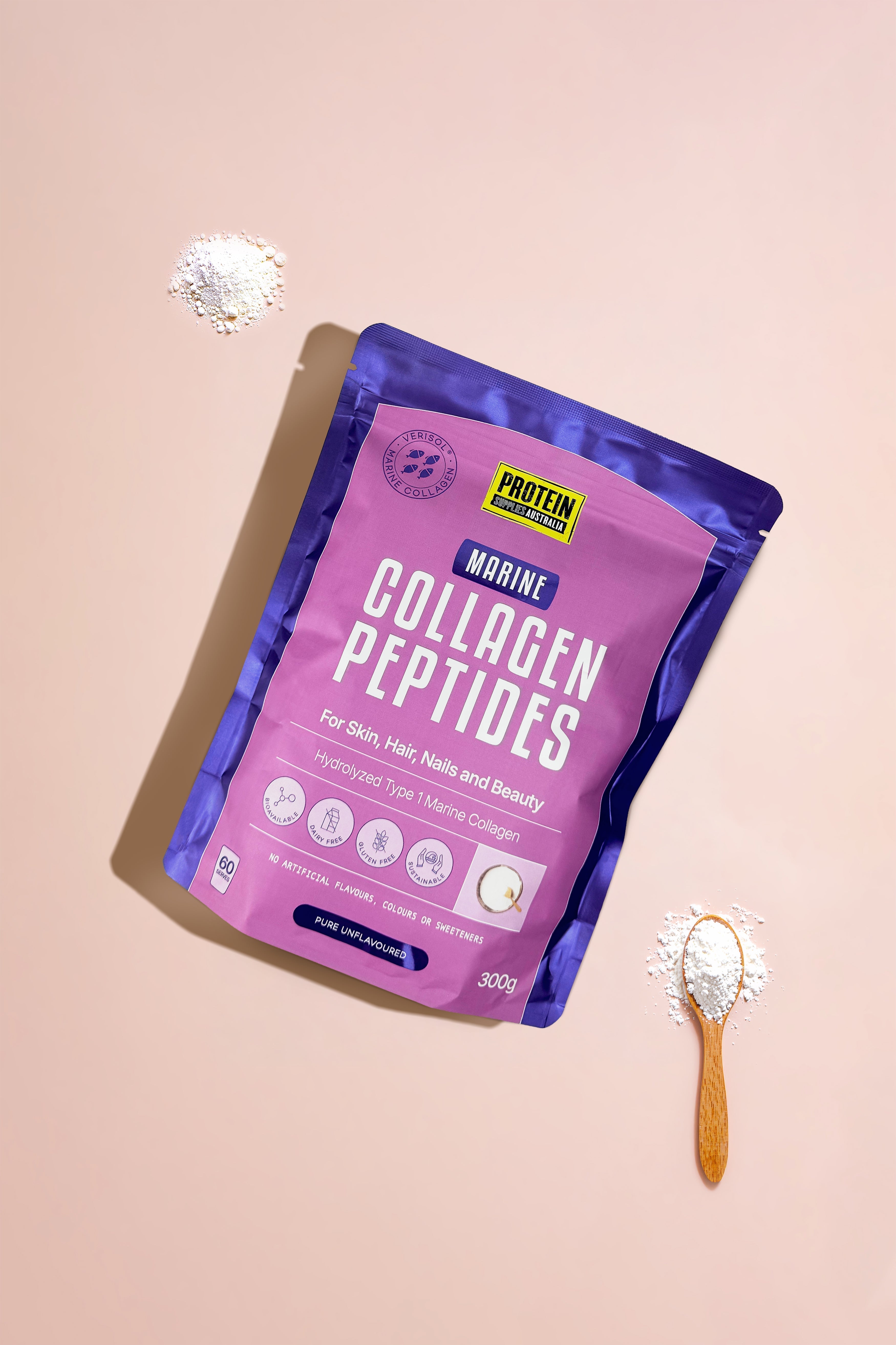
PSA's Marine Collagen Peptides uses VERISOL® F - the same clinically validated ingredient used in the Proksch 2014 and Hexsel 2017 trials. It's sourced from wild-caught fish, contains a single ingredient, and is independently tested.
What you get:
-
VERISOL® F bioactive collagen peptides
-
Wild caught marine collagen from sustainably sourced whitefish
-
No fillers, no flavours, no additives
-
Independently batch-tested
-
Unflavoured - mixes into anything
If you want a marine collagen supplement that matches what the clinical research actually used, this is it.
Check article Marine Collagen vs Bovine Collagen
Check article Marine Collagen for skin
Useful sources
-
Proksch E et al. (2014). Oral Supplementation of Specific Collagen Peptides Has Beneficial Effects on Human Skin Physiology. Skin Pharmacology and Physiology. pubmed.ncbi.nlm.nih.gov/24401291
-
Hexsel D et al. (2017). Oral supplementation with specific bioactive collagen peptides improves nail growth and reduces symptoms of brittle nails. Journal of Cosmetic Dermatology. pubmed.ncbi.nlm.nih.gov/28786550
-
Hwang SB et al. (2022). Hair Growth-Promoting Effects of the Fish Collagen Peptide. International Journal of Molecular Sciences. pmc.ncbi.nlm.nih.gov/articles/PMC9569759
-
León-López A et al. (2019). Hydrolyzed Collagen - Sources and Applications. Molecules. pmc.ncbi.nlm.nih.gov/articles/PMC6891674
-
Australian Institute of Sport - Collagen Support guidance. ausport.gov.au/ais/nutrition/supplements/group_b/other/collagen-support
-
GELITA VERISOL® F ingredient information. gelita.com
-
Healthdirect Australia - Collagen supplements. healthdirect.gov.au


Marine Collagen for Skin: What the Science Actually Says